
Belly button surgery, aka umbilicoplasty, is a thing, and it’s a rising trend. As the season shifts to summer, people show more skin, and if they’re feeling self-conscious about their belly button, plastic surgeons can offer a quick fix.
In a time when ribcage bragging is trending, it’s a challenge not to feel self-conscious about your body, even its tiniest parts. As plastic surgery has become more accessible, less-invasive, and more affordable than in the past, people are electing to tweak the slightest perceived imperfections, like your belly button. RealSelf, a community-driven website composed of information about aesthetics medicine and cosmetic treatments, just released a report claiming that belly button surgery is up 18 percent in the U.S. this year compared to last. Additionally, the U.K. shows even higher growth, with interest up 26 percent this year compared to last.
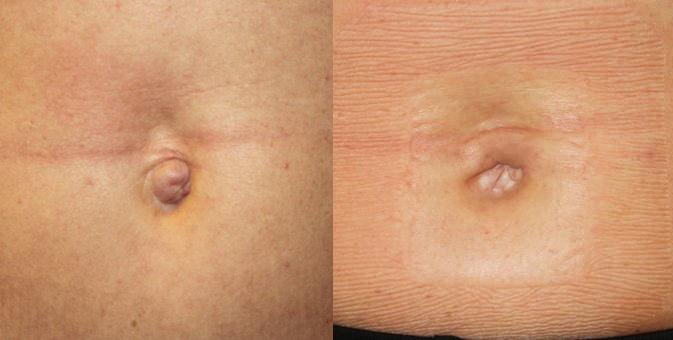
Before and After Belly Button Surgery, Courtesy of RealSelf
RealSelf Contributor Dr. David Shafer, a board certified plastic surgeon who trained at the Mayo Clinic and has a private practice in New York City, says, “Patients have a lot of concern about their belly buttons because it’s a visible part of their body. Especially in the summertime, when patients are at the beach or wearing crop tops, which have gained popularity thanks to the athleisure trend, the belly button is visible and patients want to look their best.”
Shafer goes to to say there are generally four reasons people elect to have belly button surgery:
1. A previous belly button ring has left a hole patients want closed.
2. Previous surgery such as laparoscopy, which leaves a small incision in the belly button leaves patients with a scar they want fixed.
3. The patient has an “outie” belly button and desires an “innie.”
4. Umbilical hernia after pregnancy occurs, where the skin and underlying muscles stretch out in the belly button and the patient wants it returned to its former state.
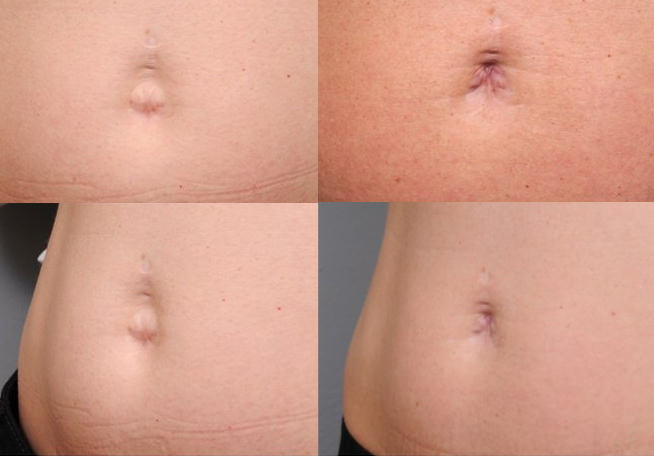
Before and After Belly Button Surgery, Courtesy of RealSelf
“There’s no standard on how a belly button should look,” Shafer tells me. However, he does note that most people have “innie” belly buttons, so it’s not uncommon for people to be self-conscious about having an “outtie.” He adds, “People have their own aesthetic.”
Costing about $2,300, belly button surgery can take as little as fifteen minutes and up to an hour-and-a-half, depending on the underlying issue.
Shafer says that he will only perform the surgery on healthy people, people who are not on blood-thinning medication, and on people with realistic expectations. He will not perform any kind of plastic surgery if he senses a patient has body dysmorphia and are “not seeing reality, but rather are seeing a projected psychological issue.” In this case, he will recommend psychological care.
Frequently Asked Questions
Belly button surgery, or umbilicoplasty, is a cosmetic procedure that alters the appearance of the belly button. It can address issues like scars, holes from piercings, or change an "outie" belly button to an "innie." The surgery is becoming increasingly popular, especially during warmer months when the belly button is more visible.
The rise in belly button surgery is linked to increased body consciousness and trends like athleisure and crop tops that expose the midriff. Additionally, plastic surgery has become more accessible, less invasive, and more affordable, encouraging people to correct even minor perceived imperfections such as their belly button.
People typically seek belly button surgery to close holes left by previous belly button rings, fix scars from surgeries like laparoscopy, convert an "outie" belly button to an "innie," or repair an umbilical hernia caused by pregnancy that stretches the skin and muscles around the belly button.
Belly button surgery usually takes between 15 minutes to an hour and a half, depending on the complexity of the issue. The average cost is around $2,300, but this can vary based on the surgeon and location.
Yes, surgeons typically require patients to be healthy, not on blood-thinning medications, and have realistic expectations about the results. Those with body dysmorphia or unrealistic perceptions may be advised to seek psychological care instead of surgery.
There is no universal standard for how a belly button should look. While most people have an "innie," aesthetic preferences vary widely, and surgeons tailor the procedure to each patient's desired appearance.
Yes, belly button surgery can effectively reduce or eliminate scars caused by previous procedures like laparoscopy, improving the overall appearance of the belly button area.
An umbilical hernia occurs when the skin and muscles around the belly button stretch out, often after pregnancy. Belly button surgery can repair this by restoring the belly button to its former shape and tightening the surrounding tissues.
Belly button surgery is generally suitable for healthy individuals with realistic expectations. Surgeons avoid performing the procedure on patients with psychological conditions like body dysmorphia and recommend psychological support instead.
Interest in belly button surgery has increased significantly, with an 18% rise in the U.S. and a 26% rise in the U.K. compared to the previous year, reflecting growing demand for cosmetic enhancements of small body features.


