
My provider
New York City board-certified plastic surgeon Dr. David Shafer
Why I tried it
When the Covid-19 pandemic began in early March, forcing all nonessential medical offices to close, I was an advocate of the move. I realized it would be a huge inconvenience for the doctors and their patients, but I also knew that staying at home was the right thing to do in order to flatten the curve and reduce the spread of the virus. But about a month and a half into my quarantine, I noticed a small (yet significant) line between my eyebrows. It was something I hadn’t seen before, since I’d started getting preventive Botox four years ago, at the tender age of 20, knowing that a couple of injections every few months would ward off my brow-furrowing tendencies and preserve my youth in the long run. Yet here I now was, with the very thing I’d been fighting against all these years.
In the weeks that followed, I watched as doctors began reopening their doors, first prioritizing their backlogs of surgeries and medically necessary skin checks, and anxiously waited for the green light for cosmetic injectables.
My concerns
Finally, on June 15, the big moment arrived. Dermatologists and plastic surgeons were officially allowed to perform Botox, filler, and laser treatments once again in New York City, where I’m based. But as desperate as I was to get back to my pre-pandemic forehead, the prospect of going to a doctor’s office terrified me. I had reentered the world only a week earlier, after 87 straight days in my apartment. I hadn’t so much as gone for a walk or to the grocery store during that time and was slowly easing my way back into society, not yet fully comfortable seeing friends or going indoors.
Ultimately, I decided to book an appointment with Dr. Shafer, knowing there would certainly be a new set of social-distancing protocols and safety precautions in place at every practice, to lower the risk.
What the appointment was like
The day before my appointment, I received a call from Dr. Shafer’s office, to confirm my visit and to run through the newly adopted set of questions to filter out any potential COVID-infection risks. I was asked about my recent travel, my exposure to others, whether I’d been around anyone who’d tested positive for the virus or exhibited any symptoms, and whether I was experiencing any symptoms. I passed the test, but I was told that if I’d answered yes to any of the questions or had any reason to suspect that I’d contracted COVID, I would have been asked to postpone my appointment.
When the big day finally arrived, rather than take the subway as I would have in the past, I opted to walk the 25 blocks to Dr. Shafer’s midtown office, wearing a bulky N95 mask over my face. I expected to feel more uncomfortable and nervous than I did, but even though the experience was different in many ways, it felt oddly natural. Nonetheless, a lot of protocols were different—here’s how my appointment went.
-
- As I walked into the expansive practice, I first stopped for a squirt of the hand sanitizer affixed to the wall before being greeted by a receptionist who sat behind a large glass divider.
- After checking me in, she did a quick temperature check, scanning my forehead with the device from a foot away. Once I got the OK, she directed me toward a large waiting room to fill out some paperwork.
- I was scheduled for the last appointment of the day, so not only was I the only patient in the waiting room, but the entire office was nearly empty.
- Many doctors have had to reduce the number of patients they can see daily in order to ensure they do not cross paths in the common areas and risk infection, but Dr. Shafer’s office is incredibly spacious. As such, he is still able to operate at about 90% of his pre-pandemic capacity, with most patients being sent straight to their respective treatment rooms.
- Dr. Shafer entered about a minute later, avoiding a handshake greeting and settling into a chair on the other side of the room. We both kept our masks on as he asked about my previous Botox injections and what I wanted to have done.
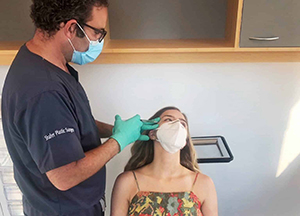
- A few minutes later, he led me to a treatment room, which had been fully sanitized after its previous inhabitant. Since I was only having my glabellar, upper forehead, and crow’s-feet areas injected, he explained that I’d be able to keep my mask on (a major relief, since I hadn’t yet been anywhere in public without a mask).
- Dr. Shafer put on fresh gloves and wiped my skin clean before injecting me. The whole process took only a few minutes—and before I knew it, I was sent on my way with an ice pack, to help decrease the redness.
In the days that followed, I waited attentively for the Botox to kick in and effectively start working its magic, running through my various facial movements in the mirror almost hourly. Within a day, I noticed my eyes looked fuller and less squinty every time I smiled, a result of the crow’s-feet injections. After that, the creases on my forehead disappeared as I raised my eyebrows. And finally, on the fourth day, that conniving little line just above my nose faded back into oblivion.
While there are, of course, much bigger issues in the world right now than the small wrinkle between my brows, even the smallest return to a regular pre-COVID behavior goes a very long way these days. I haven’t found the comfort needed to see my friends without a mask and six feet of distance, but erasing the threat of wrinkles for the foreseeable future was just the win I needed.
Frequently Asked Questions
The author noticed a small but significant wrinkle between their eyebrows about a month and a half into quarantine, despite having had preventive Botox treatments for years. They wanted to maintain their youthful appearance and decided to resume Botox treatments once clinics reopened.
Dr. Shafer's office implemented several safety protocols including pre-appointment COVID-19 screening questions, temperature checks upon arrival, hand sanitizing stations, glass dividers at the reception, mask requirements for both staff and patients, and thorough sanitization of treatment rooms between patients.
The author was initially terrified to return to an in-person appointment after 87 days of strict quarantine and limited social interaction. However, the experience felt surprisingly natural due to the safety protocols and the spacious office environment, which helped ease their anxiety.
The author received Botox injections in the glabellar area (between the eyebrows), upper forehead, and crow’s-feet (around the eyes). These targeted areas helped reduce wrinkles and improve facial expressions while allowing the author to keep their mask on during treatment.
The author began noticing changes within a day, such as fuller eyes and less squinting when smiling. By the fourth day, the wrinkle between the eyebrows had faded significantly, indicating the Botox was effectively working.
Post-treatment, the author noticed their eyes appeared fuller and less squinty when smiling, the forehead creases diminished when raising eyebrows, and the wrinkle between the eyebrows disappeared, restoring a smoother, youthful appearance.
During the early stages of the pandemic, nonessential medical offices, including those offering cosmetic treatments like Botox, were closed to reduce virus spread. Treatments resumed only after restrictions eased, with new safety protocols in place to protect patients and staff.
Instead of taking public transportation, the author chose to walk 25 blocks to the appointment while wearing a bulky N95 mask to minimize exposure risk and maintain personal safety during the pandemic.
Dr. Shafer reduced patient overlap by spacing appointments, implemented health screenings, enforced mask-wearing, used physical barriers like glass dividers, and sanitized treatment rooms thoroughly. Despite these changes, his spacious office allowed him to operate at about 90% of pre-pandemic capacity.
Because the author was still cautious about public exposure and had not yet felt comfortable being indoors without a mask, being able to keep the mask on during treatment provided significant reassurance and comfort during the procedure.


